
In short: before signing an apartment lease agreement in Vietnam, check that the person signing owns the unit or has written authority, that rent, deposit and what’s included are written clearly in VND, that there is a diplomatic clause letting you leave early if your job moves you, that repairs and rent increases are covered, and that you have a bilingual contract plus a signed inventory with photos. Most disputes we see come from one of these points being vague.
Leases in Vietnam are usually simple documents of a few pages. That’s good – but it also means important points are often left out, and what’s not written down is hard to argue about later. Here’s how to read one like a local agent would.
The basics of an apartment lease agreement in Vietnam
- Leases are normally 6 or 12 months, with rent paid monthly or quarterly in VND.
- The deposit is usually one to two months’ rent.
- A written contract is required. Leases between individuals don’t have to be notarised, though either party can ask for it.
- Contracts are often bilingual. Agree which language prevails if the versions differ – ideally both are equally valid.
Clause by clause: what to check
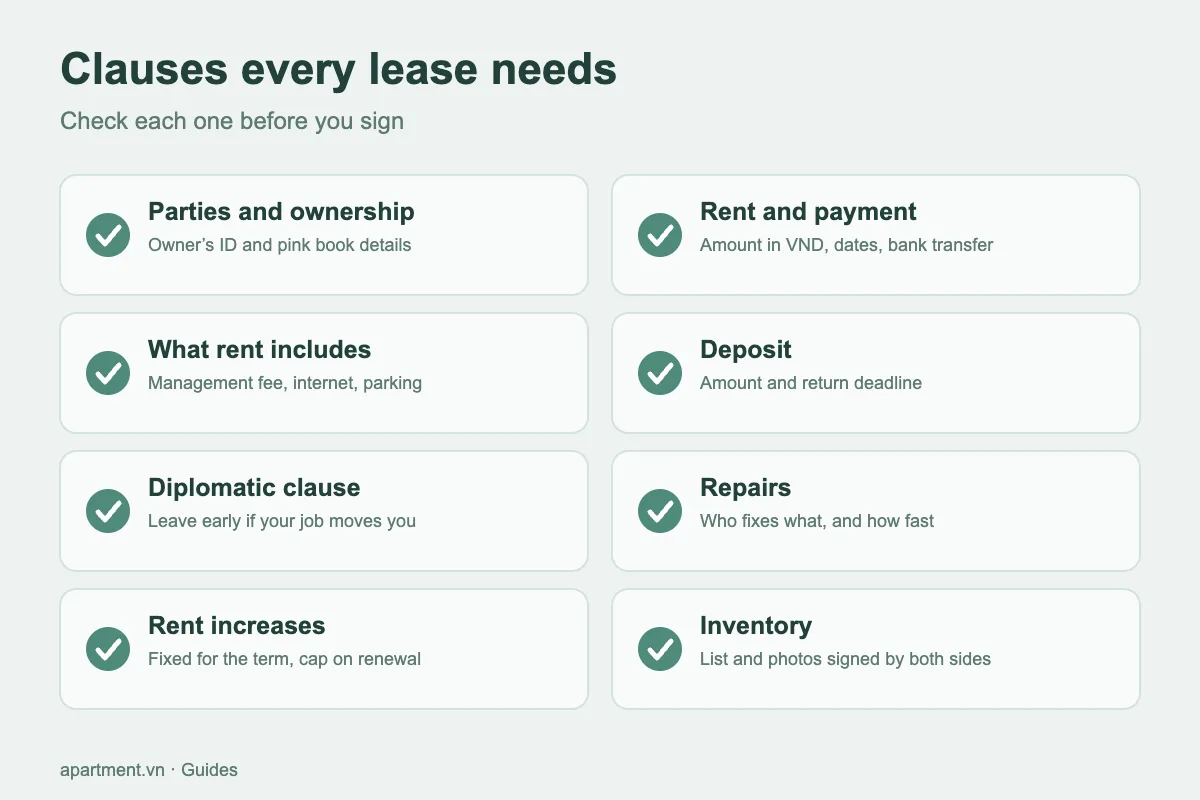
1. The parties and the property
The owner’s name, ID number and pink book details should match their documents. If a relative or company signs, ask for a written authorisation or company stamp. Include the full address, unit number and size.
2. Rent, payment and what’s included
Write the rent in VND, the due date and how to pay – bank transfer gives you a record. List what’s included: management fee, internet, cable TV, parking, cleaning. If electricity is billed by the owner, write the rate per kWh.
3. The deposit
State the amount, what it can be used for (unpaid bills, damage beyond normal wear) and how many days after move-out it will be returned. “After inspection” with no deadline is a common source of disputes.
4. Early termination and the diplomatic clause
Most leases say you lose the deposit if you leave early. A diplomatic clause lets you end the lease with notice – usually 30 to 60 days – if your employer transfers you out of the city or country, and get your deposit back. Ask for it before you sign; owners used to expat tenants expect it.
5. Repairs and maintenance
Separate normal wear (owner pays) from damage caused by the tenant (tenant pays). Add how quickly the owner must fix broken appliances such as air conditioners and water heaters – a week without air conditioning in April is not a small issue.
6. Rent increases and renewal
Rent should be fixed for the lease term. If you might renew, agree a cap or a notice period for any increase.
7. Inventory and condition
Attach a list of furniture and appliances, with photos of their condition, signed by both sides. It takes half an hour at move-in and protects your deposit at move-out.
8. Temporary residence and house rules
The owner or building must declare your temporary residence to the police within 12 hours of moving in. Mention it in the lease, along with building rules on pets, visitors and renovations.
Red flags
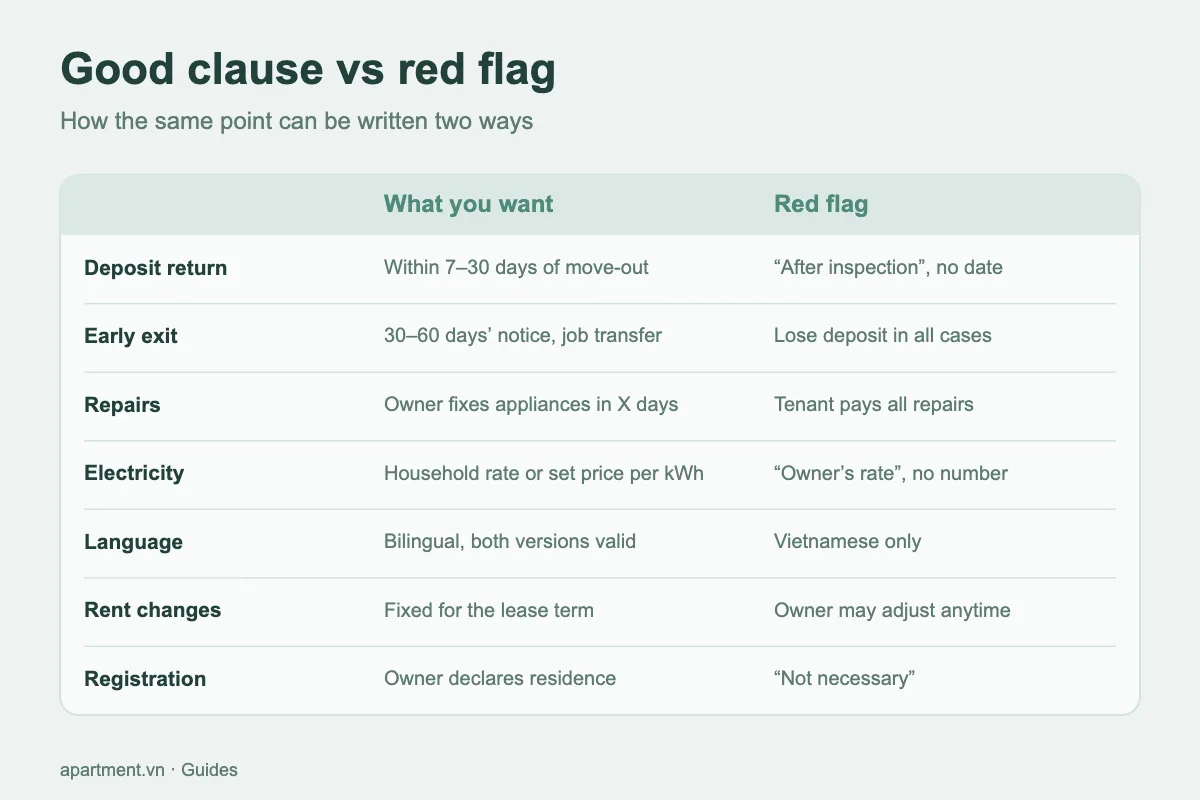
- The person renting to you can’t show the pink book or written authority.
- A deposit is requested before you’ve seen the owner’s documents.
- Vietnamese-only contract with no translation.
- Owner says police registration “isn’t necessary”.
- Rent or electricity rates that can be changed “as agreed” with no numbers.
Get help with your lease
When you rent through Apartment.vn, we check ownership documents and go through the lease with you before you sign. Browse apartments for rent in Ho Chi Minh City, read our step-by-step renting guide, or send us a lease to look over. For the costs that sit outside the lease, see our guide to deposits, fees and hidden costs.
This guide is general information, not legal advice.
An apartment lease agreement in Vietnam sits within the housing rules in the Housing Law No. 27/2023/QH15 (English text), and your landlord’s duty to register you is set out in the Immigration Department’s guidance on declaring foreigners’ residence.
Frequently asked questions
Does a lease in Vietnam need to be notarised?
A lease between individuals does not have to be notarised, but it must be in writing. Either party can choose to notarise it for extra certainty.
What is a diplomatic clause in a Vietnamese lease?
It lets the tenant end the lease early with notice, usually 30–60 days, if their employer transfers them, without losing the deposit. It is common in expat leases but must be written in.
How much is the deposit for an apartment in Vietnam?
Usually one to two months’ rent, plus the first month or quarter in advance.
Can the landlord raise the rent during the lease?
Not if the lease fixes the rent for the term. Make sure it does, and agree how renewals will be priced.
What language should the lease be in?
Ask for a bilingual English–Vietnamese contract and agree that both versions are equally valid, or which one prevails.