
In short: yes – foreigners buy property in Vietnam every day, within clear limits. Under the 2023 Housing Law, a foreign individual who has legally entered the country can own an apartment in a commercial housing project, as long as the building hasn’t reached its 30% foreign quota. Ownership lasts 50 years from the date the pink book is issued and can be extended once. What you can’t own is the land itself.
We get this question from almost every foreign buyer we meet, usually followed by “is it safe?”. The honest answer: the rules are clear and buying is routine in projects like Vinhomes Central Park, Thu Thiem and Masteri, but you need to check a few things that local buyers never think about. This guide covers what the law allows, what it doesn’t, and how the process works in practice.
When foreigners buy property in Vietnam: who qualifies
The Housing Law No. 27/2023/QH15, in force since 1 August 2024, allows these foreign buyers to own housing:
- Foreign individuals who are permitted to enter Vietnam. In practice that means a valid passport with a visa, visa exemption or temporary residence card. People with diplomatic or consular immunity are excluded.
- Foreign-invested companies, branches and representative offices operating in Vietnam, which can buy housing for their staff to live in.
- A foreigner married to a Vietnamese citizen who lives in Vietnam, who can own housing on the same terms as a Vietnamese citizen – without the quota or the 50-year limit.
Overseas Vietnamese with Vietnamese nationality, or who are allowed to enter Vietnam, have wider rights again. If that’s you, the rules are closer to those for locals.
What you can and can’t buy
Foreign ownership is limited to commercial housing projects – the developer-built apartments, townhouses and villas you see on our projects page. A few limits apply:
| Rule | What it means in practice |
|---|---|
| Apartments: 30% per building | Once foreigners own 30% of the units in a tower, no more can be sold to foreigners until one sells. |
| Landed houses: 10% per project, 250 per ward | Villas and townhouses are capped by project and by ward-level area. |
| Defence and security areas excluded | Some projects near military land are closed to foreign buyers entirely. |
| No land ownership | You own the apartment or house; the land stays under Vietnam’s land use system. |
| Individual houses outside projects | A house in an alley or on a street outside a commercial project generally can’t be bought by a foreign individual. |
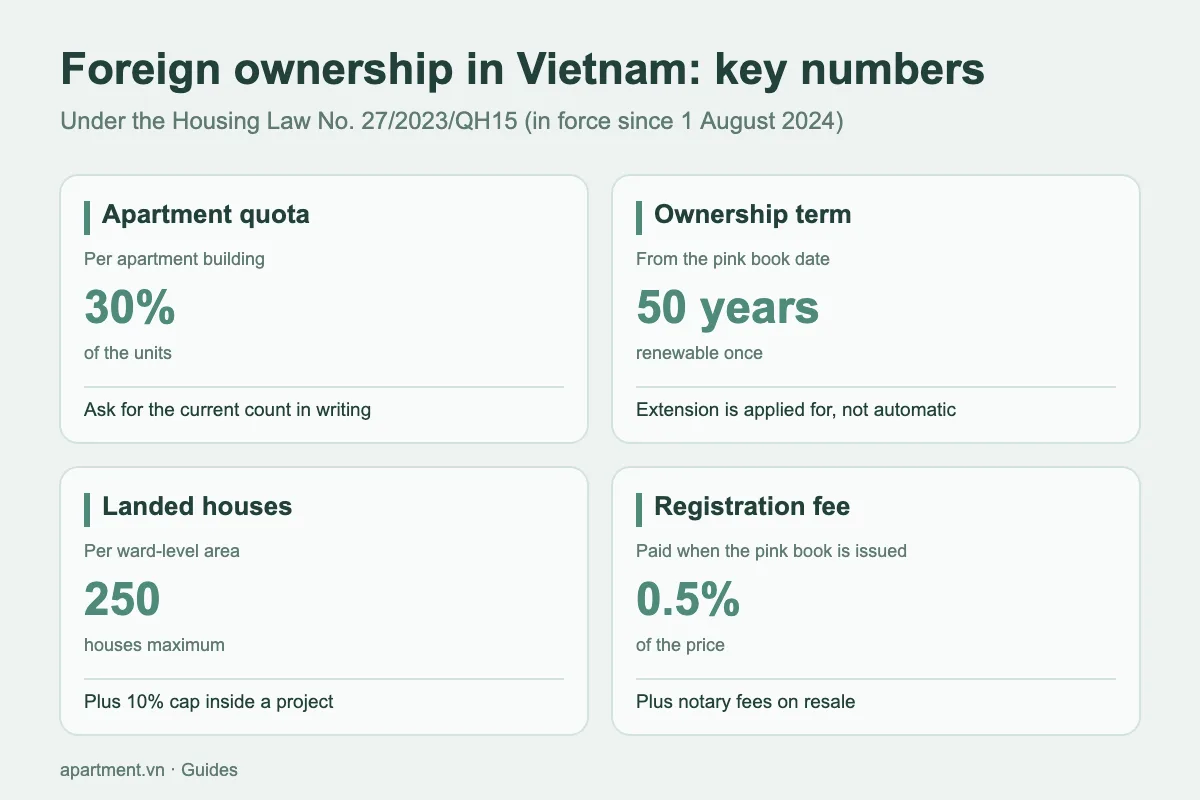
The quota is the rule that catches people out. Popular towers in Thu Thiem and Thao Dien can fill their foreign allocation early. On the resale market, always ask whether the specific unit is within the foreign quota – on Apartment.vn you can tick “Foreigner eligible” in the search filters.
How long can a foreigner own property in Vietnam?
A foreign individual owns housing for up to 50 years from the date the ownership certificate (pink book) is issued. Before the term ends you can apply to extend it once, for up to another 50 years. The end date is written on the certificate.
During that time you have real ownership rights. You can live in the property, lease it out, give it away or sell it. If you sell to another foreigner, the buyer receives a new term; if you sell to a Vietnamese buyer, the property becomes long-term ownership again.
The buying process, step by step
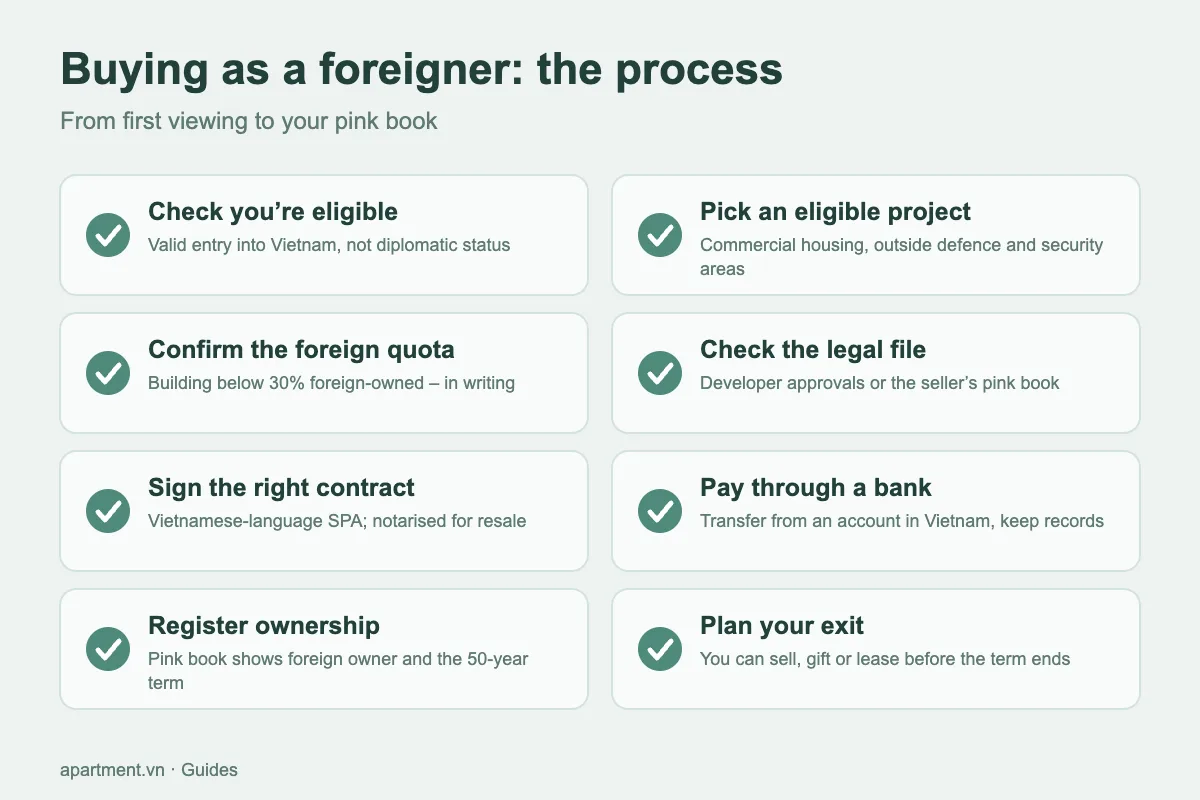
- Confirm your eligibility. Make sure your passport and visa or residence card show legal entry. Tourists can technically qualify, but a longer-term visa makes everything from bank accounts to notary appointments easier.
- Choose an eligible project. Check that the project is commercial housing and not in a restricted area. Our foreigners’ buying guide explains how to read a project’s legal status.
- Check the foreign quota. For a new launch, ask the developer how many units remain for foreigners. For a resale, ask the building management or developer to confirm the unit can be registered to a foreign owner.
- Review the legal documents. For off-plan purchases: the project approvals, the construction permit, the bank guarantee and the payment schedule. For resale: the seller’s pink book, ID and proof that the unit isn’t mortgaged.
- Sign the contract. Contracts are in Vietnamese; ask for a certified English translation. Resale contracts must be notarised. Developer contracts follow a standard form.
- Pay through a bank. Payments go by bank transfer, usually from an account you open in Vietnam with money remitted from abroad. Keep every transfer record – you’ll need them if you sell and send the money home.
- Register and receive the pink book. After handover (or after the resale transfer), ownership is registered with the land registration office. The pink book shows you as the owner and the end date of your term.
Costs to budget for
| Cost | Typical amount | Who usually pays |
|---|---|---|
| Registration fee | 0.5% of the price | Buyer |
| Notary fee (resale) | Scaled to contract value | Buyer, by agreement |
| Personal income tax on resale | 2% of the sale price | Seller, by agreement |
| Maintenance fund (new units) | 2% of the price | Buyer, paid to the building |
| Lawyer or legal check | Fixed fee | Buyer |
Financing is the other practical question. A few banks in Vietnam do lend to foreigners, usually only to those with a work permit and residence card, and on stricter terms than for locals. Most foreign buyers we work with pay in cash or arrange financing at home.
Off-plan vs resale for foreign buyers
Buying off-plan from the developer is the simplest way to stay inside the quota, because the developer manages the foreign allocation. The Law on Real Estate Business 2023 also caps how much a developer can collect before handover, which protects buyers. Resale gives you a finished unit and a pink book you can inspect, but you must confirm the unit is in the foreign quota before paying anything.
Common mistakes foreigners make
- Buying in a Vietnamese friend’s name to get around the quota. It’s not legal protection – it’s their property.
- Paying a deposit before checking the quota or the legal file.
- Signing a Vietnamese contract without a proper translation.
- Ignoring how you’ll send money home after a sale – keep your inbound transfer records.
- Assuming a foreigner can buy any house in the city. Outside commercial projects, the answer is usually no.
Find property foreigners can buy in Vietnam
Apartment.vn marks foreigner-eligible units and shows each project’s legal status, so you can start with the right shortlist. Browse apartments for sale in Ho Chi Minh City, look at Thu Thiem and Thao Dien, or contact us and we’ll check a specific unit for you. Still deciding between renting and buying? Our guide to renting an apartment in Ho Chi Minh City covers the other side.
This guide is general information based on the Housing Law 2023 and current practice, not legal advice. Rules are applied by local authorities, so check your specific case with a lawyer before signing.
When foreigners buy property in Vietnam, the law itself is the best reference: read the Housing Law No. 27/2023/QH15 (English text). For the payment rules on off-plan purchases, see Conventus Law on the off-plan rules in the 2023 Real Estate Business Law. Most foreigners buy property in Vietnam in a handful of well-known projects, so a good shortlist saves weeks.
Frequently asked questions
Can a foreigner own land in Vietnam?
No. Land in Vietnam belongs to the people and is managed by the State. Foreigners can own apartments and houses in commercial projects, plus the right to use the land under them for the ownership term, but not the land itself.
Can I buy an apartment in Vietnam on a tourist visa?
The law requires legal entry, not a specific visa type, but in practice a longer visa or residence card makes bank accounts, notaries and registration much easier. Many buyers sort out a longer visa first.
What happens after 50 years?
Before the term ends you can apply to extend it once for up to another 50 years. You can also sell or give the property to someone else at any time before the term ends.
Can foreigners rent out their apartment in Vietnam?
Yes. Foreign owners can lease their apartment, but rental income is taxable in Vietnam and needs to be declared. Many owners use a property manager to handle tenants and tax filings.
How do I know if a unit is within the foreign quota?
Ask the developer or building management to confirm in writing that the unit can be registered to a foreign owner. On Apartment.vn, the Foreigner eligible filter shows units marked as available to foreign buyers.