
In short: temporary residence registration in Vietnam is a declaration of where a foreigner is staying, and it’s filed by the person providing the accommodation – your landlord, building manager or hotel – not by you. It must be done within 12 hours of you moving in (24 hours in remote areas). Give your landlord a copy of your passport and visa on day one and ask for proof, because you’ll need it for visa extensions, residence cards and some bank accounts.
This is the part of renting in Vietnam that new arrivals most often don’t know about. At a hotel it happens quietly at check-in. In a rented apartment it depends on the owner, and some owners forget or would rather not deal with the police. Here’s how it works and how to protect yourself.
What temporary residence registration in Vietnam means
Under Vietnam’s law on the entry, exit, transit and residence of foreigners, every foreigner staying in Vietnam must have their place of stay declared to the local police through the person managing the accommodation. For a rented apartment, that’s the owner or whoever manages the unit for them. The declaration links your passport to your address for the time you live there.
It’s different from a temporary residence card (TRC). The card is a residence permit issued to people with work permits, investors and some family members. The declaration applies to everyone, whatever visa or card they hold.
How the process works
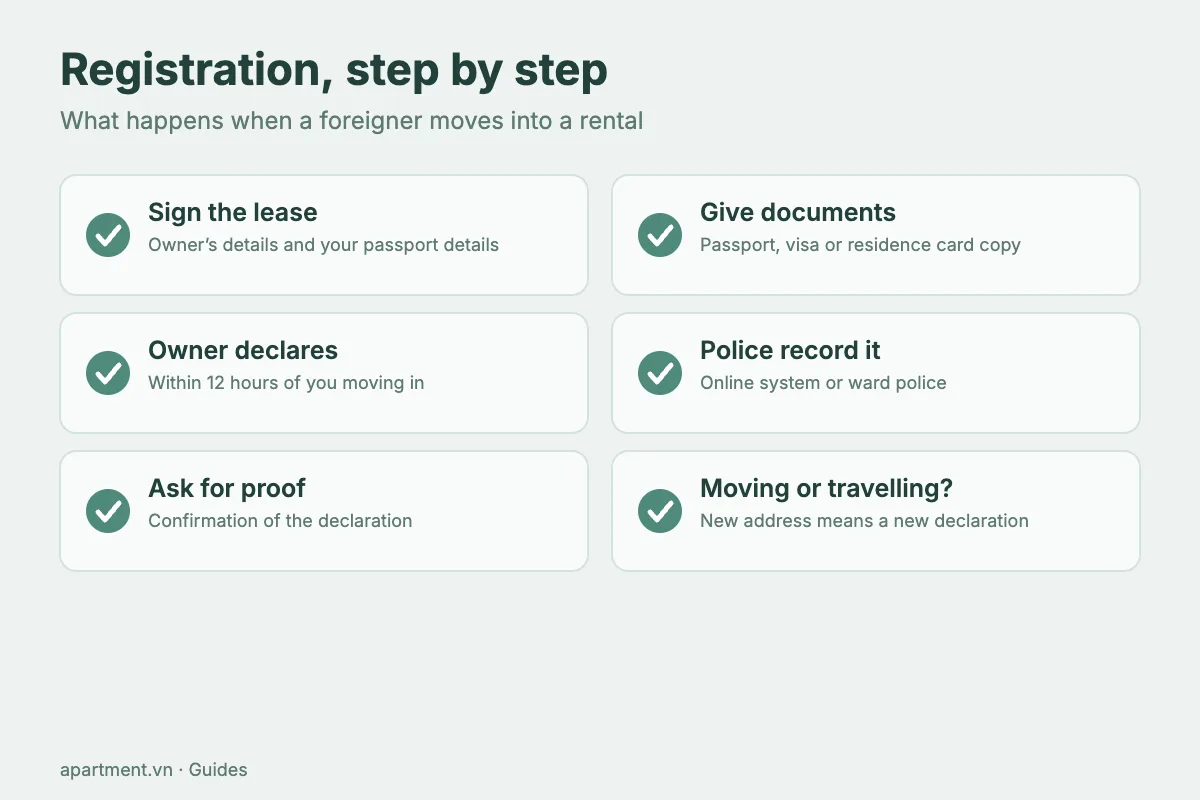
- Sign the lease. Make sure it includes your passport details and the owner’s details.
- Hand over copies. Your passport photo page, current visa or entry stamp, or your TRC.
- The owner declares. Within 12 hours, usually through the police’s online system, or in person at the ward police station.
- Get confirmation. Ask the owner for a screenshot or the confirmation of the declaration. Keep it with your lease.
- Declare again when things change. If you move to another apartment, stay elsewhere, or renew your visa, the new accommodation provider needs to declare you.
What happens if it isn’t done
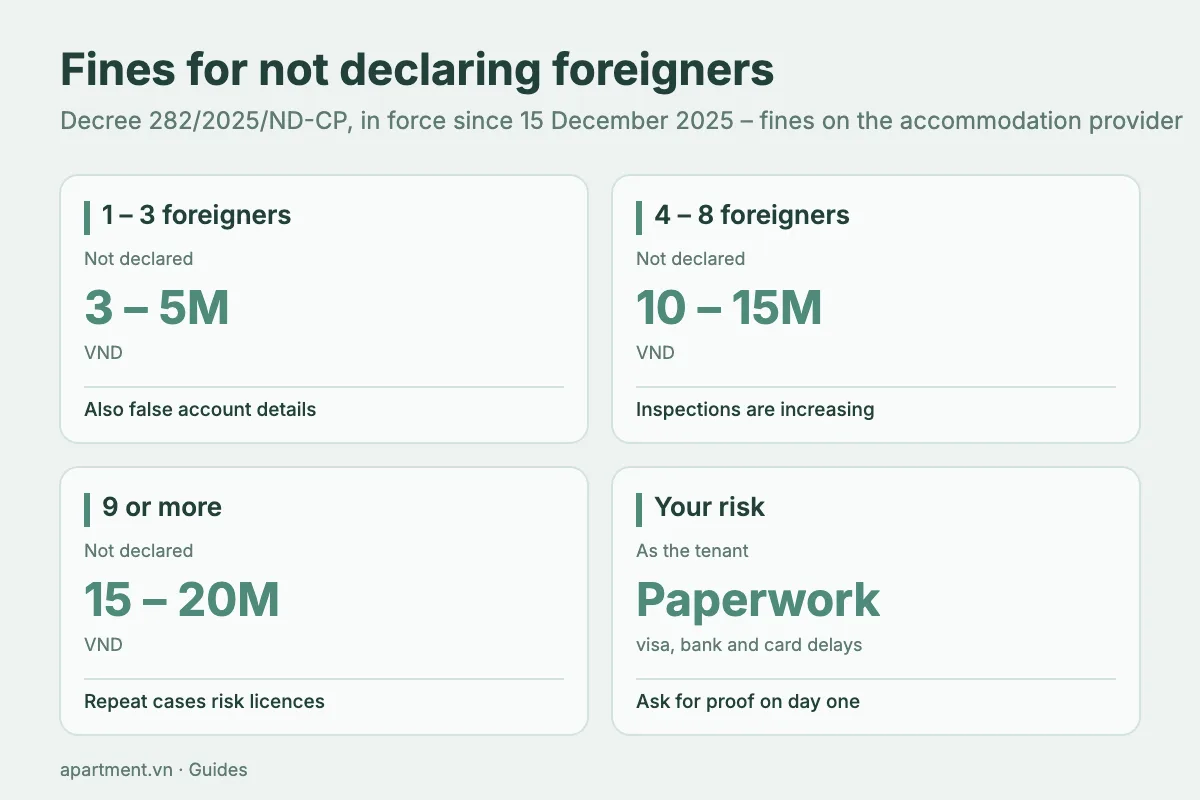
Since 15 December 2025, Decree 282/2025/ND-CP has raised the fines for accommodation providers who don’t declare foreign guests. The fines fall on the provider, but the practical problems fall on you: without proof of registration, a visa extension, a residence card application or opening a bank account can be delayed or refused.
Tips for foreign tenants
- Raise registration before you sign. A good owner will say yes without hesitation.
- Put it in the lease – our guide to the apartment lease agreement in Vietnam shows how.
- Be wary of offers of lower rent in return for staying unregistered.
- In big buildings, the management office can often help the owner with the paperwork.
- If you need written confirmation of your address, you can request it from the ward police once the declaration is on file.
Short stays and serviced apartments
Licensed hotels and serviced apartment operators declare guests as a matter of routine. For short stays in private condos, Ho Chi Minh City has required owners to register as accommodation providers since April 2026 – see our comparison of a serviced apartment vs condo.
Rent with registration sorted
Every lease arranged through Apartment.vn includes temporary residence registration. Browse apartments for rent in Ho Chi Minh City or read our step-by-step renting guide.
This guide is general information, not legal advice. Procedures are handled by local police and details can change.
Official and news sources on temporary residence registration in Vietnam: the Immigration Department’s guidance on declaring foreigners’ residence and Tuoi Tre News on the higher fines under Decree 282/2025.
Frequently asked questions
Who registers temporary residence for a foreigner in Vietnam?
The person managing the accommodation – a landlord, building manager or hotel – declares the foreigner to the local police. The foreigner provides their passport and visa details.
How long does a landlord have to register a foreign tenant?
Within 12 hours of the foreigner starting their stay, or 24 hours in remote and mountainous areas.
What is the fine for not declaring a foreigner?
Under Decree 282/2025/ND-CP, in force since 15 December 2025, accommodation providers face fines starting at 3–5 million VND for one to three undeclared foreigners, rising with the number of people.
Is temporary residence registration the same as a temporary residence card?
No. Registration is a declaration of your address that applies to all foreigners. A temporary residence card is a residence permit issued to eligible people such as work permit holders.
Do I need to register again if I move?
Yes. Each time you move to a new address, the new accommodation provider must declare you.